Ceramic White Angel in Blue Dress Playing Flute
-

Chinese porcelain blue and white large dish with flat everted rim, painted with a large wicker-work basket of flowers including prunus, peach flower, chrysanthemum, magnolia, peony and hydrangea on a stand with ruyi-head feet, beneath an upright gate-form bamboo handle tied with a ribbon at the top, the underside with branches of camellia, peony and prunus.
-

Chinese porcelain blue and white and underglaze copper-red large deep saucer dish with gently flared rim, painted in the centre with a crab encircled by four carp and a mandarin carp, with shrimp and shell amongst a shoal of copper-red fish and guppies, with aquatic plants, arrow heads, leaves and roe, all within a single underglaze blue line, the underside and base glazed white with a wide channel foot rim.
-

Chinese imperial porcelain blue and white deep dish thickly potted with gently flared rim, painted on the interior with three elderly immortals discussing their age, while standing on a rocky promontory beside their attendant and a deer, beneath overhanging rockwork and pine branches, looking out towards a sea house, with a crane in flight delivering a bamboo strip of longevity into the receptacle in the window, thus extending the lifespan of the immortal by one hundred years, the underside painted with islands and a fisherman.
-

Chinese porcelain blue and white reticulated pierced bowl, wan, the exterior painted with five medallions of river landscape, camellia, rockwork, peony and a building with a large opening beside a flagpole and rockwork, all between pierced cash-style devil's work ground, above a band of lappets and beneath a band of scrolls at the rim, the interior white, the base unglazed.
-

Chinese imperial porcelain blue and white jue stand on four bracket feet, modelled with a central 'mountain' decorated on the sides with rocks and billowing waves with a peach and leaves on the flat top, encircled by four cranes in flight amongst ruyi-head clouds, beneath a flat everted rim painted with triangular diaper, the underside with stylised lotus flowerheads and scrolling branches.
-

A Chinese porcelain small tea jar with ovoid body and short flared mouth, painted in underglaze blue and copper-red with two sections divided by double rings, the upper with poem in underglaze blue and seals in copper-red, the lower with flowering plants in copper-red and underglaze blue, the base unglazed.
-

Chinese porcelain underglaze blue and white large dish painted with four figures in a walled garden scene with a building to the right, the underside with three ruyi designs.
-
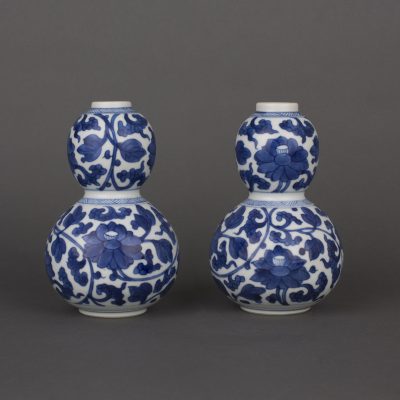
A pair of Chinese porcelain blue and white vases of double gourd form, painted on each section with lotus flower heads on scrolling branches and leaves, divided by a triangular diaper band repeated beneath the upright rim, the wide unglazed biscuit foot revealing the body.
-
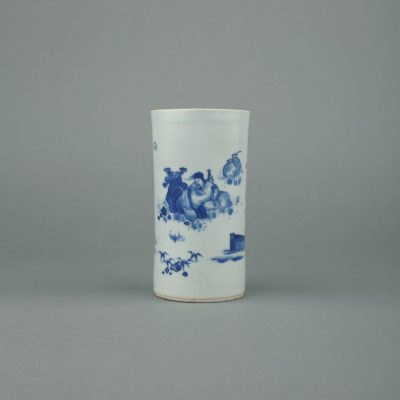
Brushpot, bitong, of cylindrical form painted with the Daoist immortal Lü Dongbin resting on rocks beside two wine jars with a seated willow tree spirit, Liushu Jing, on a fallen tree trunk playing a flute, all beneath the moon, amongst bamboo, rockwork and cloud banks in a continuous scene between anhua bands, the base unglazed revealing the dense white biscuit body.
-
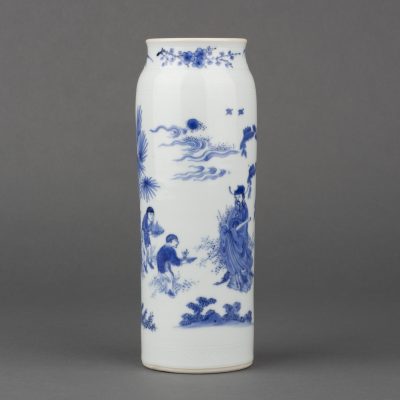
A Chinese porcelain blue and white small cylindrical sleeve vase, rolwagen, painted with a standing official holding a hu tablet, attended to by two boys, one presenting a jue, all within a continuous landscape scene with palm trees, plantain, 'v'-shaped grass and rockwork, beneath the moon amongst clouds, with birds in flight, all between anhua scrolling bands, the gently waisted neck painted with branches of bamboo, orchid and prunus.
-
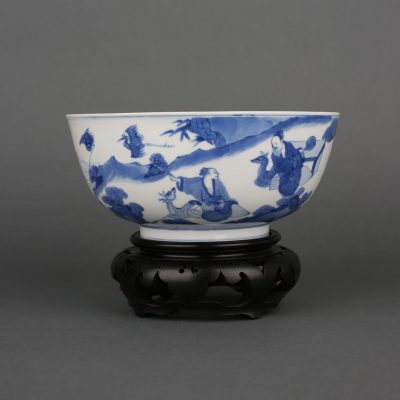
A Chinese porcelain blue and white deep bowl, thinly potted with upright sides, painted on the exterior in a continuous scene with three seated scholars amongst deer, scrolls and books, beside rock work and large pine trees, together with a scholar and attendant crossing a bridge and two cranes in flight, the well of the interior with two recumbent deer beside rock work and a large pine tree, in a mountainous river landscape scene beneath the moon and beneath an elaborate border with lingzhi and rock work.
-
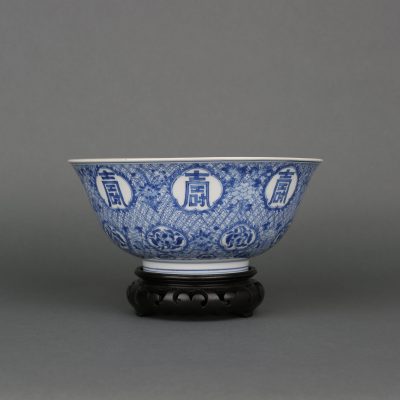
A Chinese porcelain blue and white thinly potted minyao bowl, with gently flaring rim painted on the exterior with eight shou characters dispersed between eight peaches in lingzhi shape panels, all on a dense lozenge diaper ground with lotus and peony flower heads above a band of interlaced lotus flower heads and lingzhi, the interior painted in the well with a peach medallion encircled by lingzhi, lappets and further interlocked pairs of lingzhi on a diaper ground beneath a rectangular flower head band at the rim, the base with a six character mark of Chenghua within a double ring in underglaze blue.
-
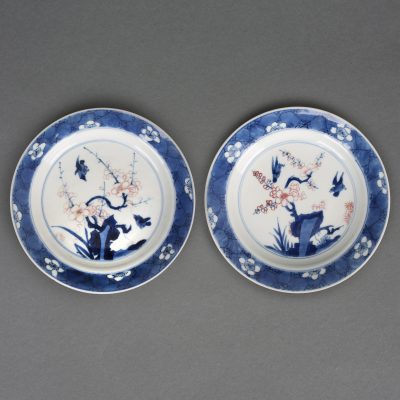
A pair of Chinese porcelain blue and white and underglaze copper-red small plates each painted with the three friends of winter, sanyou, with two birds in flight between a large prunus tree with small sprays of bamboo and pine needles, heightened in copper-red, encircled by a 'cracked ice' blue ground prunus flower head border, the underside with three branches of flowering chamellia, the base with a six-character mark of Chenghua within a double ring in underglaze blue.
-
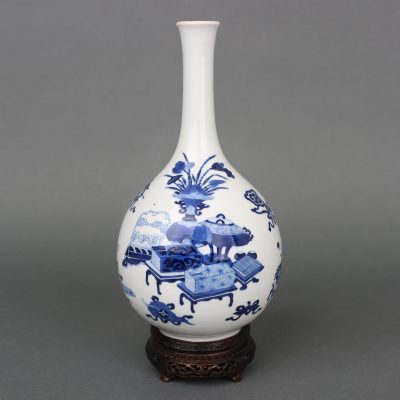
A Chinese porcelain blue and white bottle vase, with rounded body and tall cylindrical neck and gently flaring rim, painted over all in 'One Hundred Antiques' decoration, including books, table screen, tripod incense burner, sceptor, weiqi board and counters, ribbon tied music stone, ribbon-tied leaf and pearl, wrapped qin, jue, fan, brush and axe, rings, vase with lotus flower and leaves and vase with peacock feathers and coral branch, ribbon tied cornucopia and ribbon tied leaf with water dropper. The base with a double ring in under glaze blue.
-

A pair of Chinese porcelain blue and white reticulated square form teapots and covers, each with openwork panels of wave fretwork and honeycomb, between four sided handles and spouts, all on diaper grounds, with mallow flower heads, all supported on four bracket feet.
-
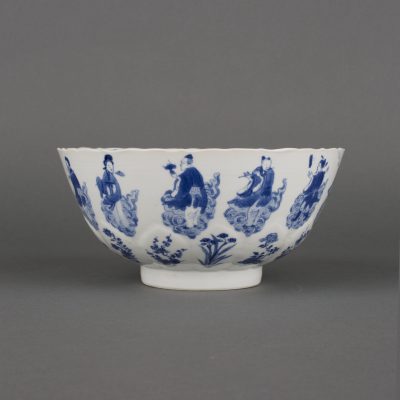
A Chinese porcelain blue and white bowl with lobed rim painted on the exterior with twelve immortals in the clouds, all above a moulded band of lotus petals, each painted with a branch of flowers and foliage, the interior well with a further immortal holding a peach branch over his shoulder on a cloud bank below a wide band at the rim of cash heightened with blossoms all on a blue ground.
-

Chinese porcelain blue and white moulded and fluted deep bowl, wan, with foliate rim painted on the exterior with four equestrian huntsmen and hounds in pursuit of white hares, amongst rockwork and trees, above a relief petal band interspersed with lingzhi branches and precious objects on a key-fret ground, the interior painted in the well with a further equestrian huntsman encircled by lappets and precious objects, beneath a wide band of diaper wan characters.
-

Chinese porcelain blue and white, underglaze copper-red and white-slip-decorated celadon-ground rouleau vase, decorated with the "Eight Horses of Mu Wang", each in a different pose amongst pine trees, wutong, rockwork and clumps of grass, the lip and interior glazed white, the base with an underglaze-blue double ring.
During the early Ming dynasty (1368 – 1644), the supply of cobalt oxide from Persia was briefly halted due to foreign trade restrictions and a locally-mined cobalt was used. It's high concentration of manganese resulted in a softer, more pale blue and it continued to be used all the way through the reigns of emperors Xuande, Chenghua and Zhengde through the fifteenth and early sixteenth centuries.
It was also at this time that smalt cobalt – achieved by mixing cobalt oxide with molten glass and brought to China by Zheng He's maritime expeditions – was used to create stunning blue and white Chinese pottery. It resulted in brilliant blues visible in the glazed surfaces of blue and white china antique plates, blue and white china antique vases and blue and white china antique bowls.
As was their wont, the desirability of what has become antique blue and white stoneware was largely dependent on the tastes of each emperor. The fifth Ming emperor Xuande enjoyed Mineral Blue (shizi qing) from Jiangxi province mixed with Muslim Blue (huiqing) from predominantly Central Asia. This generated a deeper purplish-blue tone while the favoured blue and white Chinese porcelain of the ninth Ming emperor Chenghua used the locally-sourced cobalt with high concentrations of manganese, resulting in a paler hue for the blue and white ceramics produced for his Imperial court.

Famille Rose
Objects of the aforementioned colour palette primarily identified by the use of a pink enamel.

Ming & Earlier
Objects from the Ming, Song and other dynasties.

Japanese & Korean
Japanese and Korean ceramics.
Source: https://www.marchantasianart.com/shop/porcelain-works-of-art/chinese-blue-and-white-porcelain-ceramics/page/3/
0 Response to "Ceramic White Angel in Blue Dress Playing Flute"
Post a Comment